
Why the timeless foundations matter more than ever in an AI-driven, product-led era.
In 2018, Brandon Chu (then GM, Platforms at Shopify) wrote a piece, The First Principles of Product Management, that I continually referenced concerning the First Principles of Product Leadership and how to think and operate as a coach, which fits the role and responsibilities perfectly:
“A coach doesn’t play. They are hired to support a team, and do so by helping them increase their individual and collective potential. They are measured – by the team and owners alike – by winning. Generally, if a team doesn’t win, the coach is fired, not the players.”
Yet, as we are in the midst of the next (and maybe most impactful) inflection point across product, technology and the world at large, I took the opportunity to revisit these foundational first principles, see whether they are still as applicable today, or whether they have changed and also how product leaders in today’s world should approach these.
Why We Need to Revisit the Foundations
In 2025, the job of a product leader has never been more complex – or more critical.
Markets shift overnight, customer expectations evolve in real time, and AI is redefining what’s possible in both product delivery and customer experience.
With all this change, it’s tempting to get lost in the noise – chasing trends, reacting to competitors, stacking more tools into an already bloated tech stack. But the truth is, the best product leaders don’t start with what’s hot. They start with what’s timeless.
This is where First Principles come in. They are the foundation we return to when everything else feels uncertain. They strip away assumptions, challenge the status quo, and anchor our decisions to what truly matters.
What “First Principles” Mean Today
First principles are the fundamental truths of product management – the ones that don’t change even as tools, markets, and technologies do. So, therefore, they remain as true today as they ever have. They are the bedrock you can always return to when navigating ambiguity.
The original idea remains:
A first principle is something that is undeniably true, and everything else should be built on top of it.
Yet today, they need to work harder than ever before:
- They must accommodate the AI age – where speed, scale, and automation can either sharpen your impact or amplify the wrong things.
- They must be flexible enough to guide distributed, cross-functional teams who often operate without a shared room, timezone, or even culture.
- They must serve both the business and the user, because misalignment here is the fastest path to mediocrity.
The Two Core Principles – Reimagined for 2025
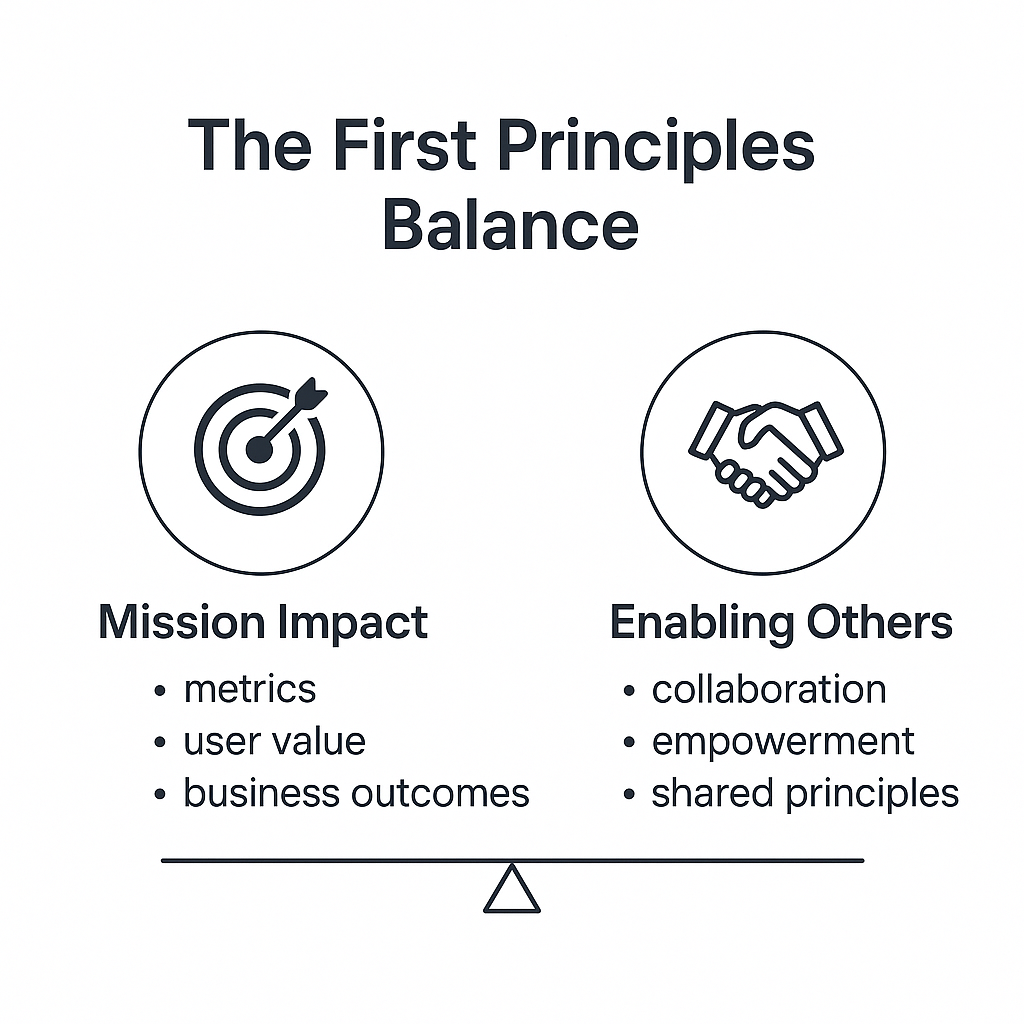
1. Maximise Impact Towards the Mission
Your job as a product leader is not to ship the most features. It’s to deliver the highest possible impact towards your organisation’s mission – given the time, resources, and constraints you have.
What’s changed since 2018?
- AI accelerates everything – meaning small bets can scale fast, but bad bets can scale even faster. The filter for what’s worth doing matters more than ever.
- Product-Led Growth (PLG) has matured – your mission must be tied to outcome metrics like activation, retention, referral, not just acquisition.
- Customer journeys are nonlinear – impact now comes from removing friction across every touchpoint, not just optimising the “main funnel.”
Taken through a modern lens:
Ask, “If we could only do one thing this quarter, what would move the mission forward the most?”
Then, make the trade-offs clear to your team, your peers, and your executives.
2. Achieve Impact by Enabling Others
You don’t build the product. You make the conditions for others to build the product.
Then vs. Now:
In 2018, enabling others meant cross-functional alignment.
In 2025, it’s cross-timezone, cross-culture, AI-augmented collaboration.
The best PMs aren’t just coordinators – they’re force multipliers, setting vision, simplifying complexity, and making sure every team member can connect their work back to the mission.
The modern enabler toolkit is now incomplete without amplification of:
- Principle-led decision making – Define a set of product principles (e.g., “Does this serve our mission? Does it solve a real user problem? Can it be explained in one sentence?”) and make them visible.
- Context-rich communication – Replace task lists with story-driven briefs that frame the why and how, not just the what.
- Empowered execution – Use data, insight and AI tools to remove bottlenecks, so teams can ship, learn, and iterate faster without you micromanaging.
Putting First Principles into Action in 2025
1. Start with Empathy + Evidence
Love the problem, not the solution. Deeply understand your users, then validate with data, experiments, and real-world behaviour.
2. Layer Lean + Agile with AI
Lean Startup taught us to start small and learn fast.
Agile reminded us to adapt and respond to change.
AI now lets us personalise, predict, and experiment at a scale that wasn’t possible before—but the principles still apply.
3. Govern by Principles, Not Opinions
Principles remove ego from decision-making. If the principle says “Serve the mission over individual preference,” the decision is already made.
Timeless Principles, Modern Practice
The world of product will always keep evolving – new tech, new channels, new competitors. But the best PMs don’t chase every change; they anchor in the principles that don’t move.
If you take nothing else from this article, remember:
Maximise mission impact – every decision, every sprint, every launch.
Enable others to succeed – your legacy is the conditions you create, not the tickets you close.
In an AI-driven, product-led era, the foundations aren’t just relevant – they’re still essential.
 can do meta